Your Front Yard Doesn't Have to Be a Lawn — And Here's What to Do Instead
How Much Water Does Xeriscaping Actually Save?
Grass is expensive to keep alive. If you're in a dry climate, it's also kind of absurd — you're essentially fighting the environment every week, running sprinklers to sustain something that has no business growing there naturally. More homeowners are waking up to this, which is why interest in front yard xeriscape design ideas has exploded over the last few years. And once you see what a well-done xeriscape actually looks like, the "boring gravel yard" stereotype falls apart pretty quickly.
The word xeriscape comes from the Greek "xeros," meaning dry — so it's literally designed around using less water. But that doesn't mean it has to look sparse or neglected. The best xeriscapes look intentional, layered, and alive. The goal is to work with your local climate instead of against it.
The Best Xeriscape Plants for the High Desert (That Actually Thrive)

Drought-Tolerant Landscaping
Use low-water plants and smart design to create beautiful, sustainable yards that thrive in dry climates—click to learn how it can save water and reduce maintenance.

Front & Backyard Design Ideas
Blend function and beauty with customized layouts, plant choices, and hardscape features tailored to your lifestyle—click to explore design inspiration for every outdoor space.

Xeric Garden & Native Plant Installations
Combine low-water, climate-adapted plants with natural design to create thriving landscapes that celebrate local beauty and require minimal upkeep—click to discover how native species can transform your yard.
Commercial & HOA Xeriscaping
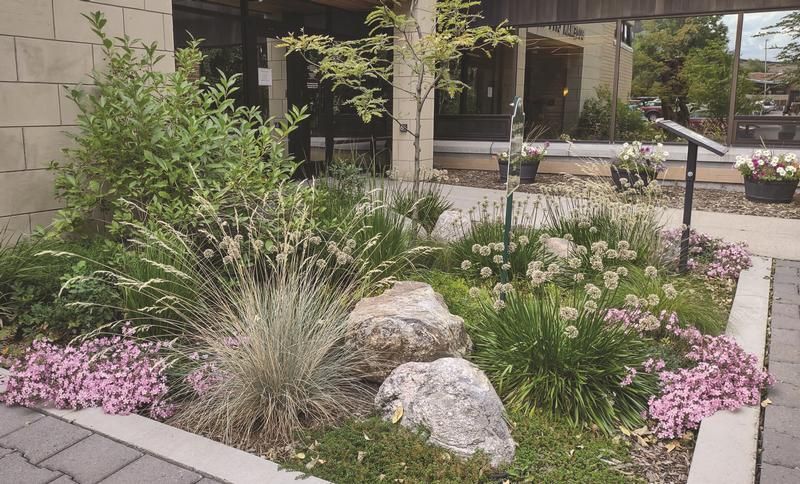
Delivers water-efficient, low-maintenance landscaping solutions tailored for businesses and communities—click to see how xeriscape design enhances curb appeal while cutting irrigation costs.


Start with the bones: hardscape and pathways. One of the biggest shifts in thinking when you move away from lawn is that your non-plant elements carry more visual weight. Flagstone paths, decomposed granite, crushed basalt, river rock — these become the canvas. A well-laid flagstone walkway cutting diagonally through a xeriscape bed immediately gives the space structure and intention. Decomposed granite in a warm tan or rust tone reads as natural and earthy rather than industrial. This is where a lot of people go wrong: they pull out the grass, dump gray gravel, and call it done. The hardscape is supposed to complement the plants, not replace them.
Choose plants that actually belong in your region. This is the most important decision you'll make. Drought-tolerant doesn't mean the same thing everywhere — what thrives in the Sonoran Desert is different from what works in Central Texas or Southern California. In the Southwest, you're looking at agave, prickly pear, desert willow, and brittlebush. In Texas, Texas sage, black-eyed Susans, and native grasses like muhly and sideoats grama are workhorses. California has its own palette: California poppy, manzanita, salvia, and flannel bush. Your local cooperative extension office is genuinely the best resource here — they publish plant lists specifically for your county.
The design principle that makes these plantings look great rather than random is layering. Think about height variation: a tall columnar cactus or ornamental tree at the back, mid-height flowering shrubs in the middle, and low groundcovers or gravel mulch at the front. Add a few accent boulders and you've got something that looks designed, not just planted.
Mulch is doing more work than you think. Once your plants are in, a 3-inch layer of organic mulch or decomposed granite around the root zones cuts evaporation dramatically. This is one of those unsexy tips that makes a massive difference — it keeps soil temperatures stable, suppresses weeds, and reduces how often you need to water while plants get established. Most drought-tolerant plants need regular watering in their first year even if they'll eventually thrive on rainfall alone. Mulch gets them through that critical window.
Think about color across seasons. One of the best front yard xeriscape design ideas that often gets overlooked is planning for bloom succession — choosing plants that flower at different times so something is always showing color. In a lot of dry climates, spring is the big show, but you can extend that with late-summer bloomers like autumn sage or desert marigold. Even in winter, structural plants like agave, ornamental grasses, and boulders keep the space looking considered rather than dormant.
Lighting is worth mentioning too. A few well-placed low-voltage path lights or uplights on a feature cactus or boulder transforms the space after dark in a way that a lawn never can. It's a small addition that makes the design feel complete.
The maintenance reality — which is what most people actually want to know — is that an established xeriscape takes significantly less time and money than a lawn. No weekly mowing, no fertilizer schedule, water bills that drop noticeably. The front-loaded effort is the design and installation. After that, you're mostly doing a seasonal cleanup and occasional pruning.
If you've been sitting on the idea, the honest nudge is this: start with one bed. Pull the grass from a section near your walkway, lay down landscape fabric and decomposed granite, plant three or four things you actually like the look of, and see how it feels. Most people who try it end up doing the whole yard within a couple of years. It just makes more sense than fighting for grass.
The consistent finding across utility studies, academic research, and real-world conversion data is that the savings are real, substantial, and lasting. Turf removal and xeriscape conversion is the single highest-impact water conservation measure available to residential homeowners in dry climates — more impactful than low-flow fixtures, shorter showers, or any indoor efficiency measure. The yard is where the water goes, and changing what grows in the yard is how you change the bill.
Get a Free Quote
Get the lawn or garden of your dreams. It’s easier than you think! Contact us today and we’ll beautify your home or commercial property. Call us at 719-414-7100 or send us a message using the form below and we’ll get back to you as soon as we can.
